Signing Lacuna Signer documents on Amazon ECS Fargate with CloudFormation
This page specifies a single-instance deployment of Bulk Signer on Amazon Web Services that signs documents created in Lacuna Signer. A user or the API creates a document in a Signer folder bound to a Bulk Signer signing profile; Bulk Signer signs it with the organization's certificate, whose private key is held in AWS KMS, and Signer stores the signed document. The deployment consists of:
- the Bulk Signer container image, running as one Amazon ECS task on AWS Fargate behind an Application Load Balancer;
- the operational store in Amazon RDS for SQL Server;
- the work share and the signing certificate in one Amazon S3 bucket;
- the signing key in AWS KMS;
- a signing profile that uses the
SignerFoldermethod; - the
Signer:WebhookSecretwebhook, through which Signer notifies Bulk Signer of new documents.
The infrastructure is the one specified in Amazon ECS Fargate. On this page a CloudFormation template creates all of it in one stack (step 5), on an empty AWS account. Three things stay outside the stack and are prepared before it: the signing key, imported from the PFX into KMS (step 2); the container image, copied into ECR (step 3); and the secrets whose values a person types (step 4). After the stack come the DNS record and the Lacuna Signer side: the profile, the webhook and a test (steps 6 to 10).
The same deployment, built command by command with the AWS CLI instead of a template, is specified in Amazon ECS Fargate + Lacuna Signer. Both pages produce the same resources and the same configuration; this one leaves fewer commands to run.
An environment already deployed by hand from Amazon ECS Fargate is not taken over by the
template. To add the Lacuna Signer integration to it, follow step 1, create the two
Lacuna Signer secrets of step 4, add the Signer settings of
Bulk Signer configuration to a new task definition revision, deploy it, and
follow steps 8 to 10.
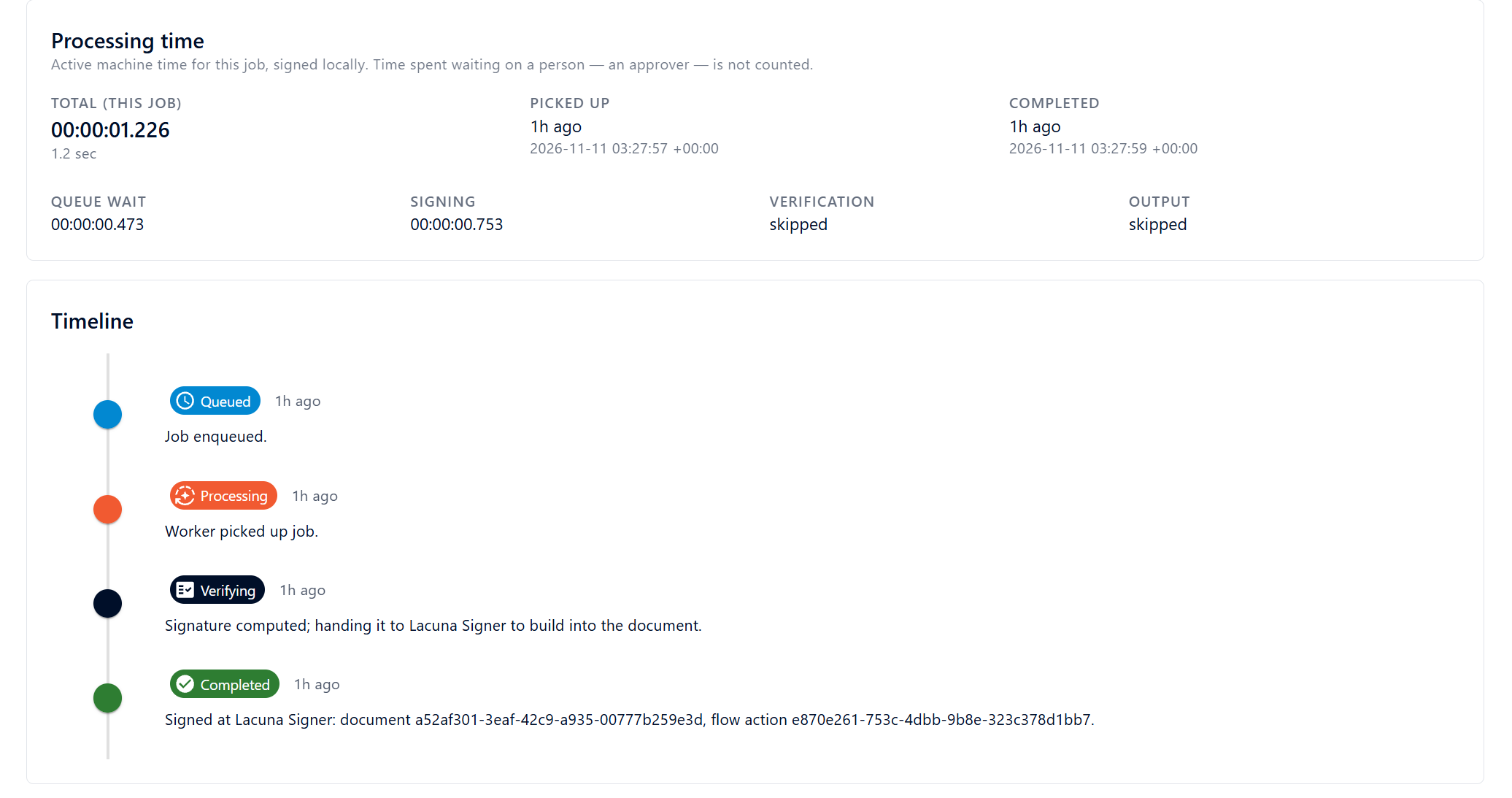
The procedure was validated in a homologation environment: a PDF created in Lacuna Signer was signed by
the Fargate task with an e-CNPJ certificate whose key was held in AWS KMS, in a job with a total
processing time of 1.2 seconds. On 2026-11-11 the template was deployed in sa-east-1 with the commands
of steps 5 and 7, on a Windows workstation with Git Bash: the stack was complete 18 minutes after
create-stack, every check of step 7 passed on the first attempt, an update with
aws cloudformation deploy took three minutes, and the stack was then deleted.
The SignerFolder method and the Signer:WebhookSecret key were introduced in 2.16.0. The
S3 storage provider, the
AwsKms certificate source and the
Auth:SessionKeyRing:Placement
key were introduced in 2.20.0. Earlier images refuse the configuration on this page at boot.
Cluster mode is supported on Azure App Service only, and an S3 work share is
refused when Cluster:Enabled is set. The ECS service the stack creates is configured so that two tasks never
run concurrently, including during a deployment. Deployments that require more than one instance must
use Azure App Service (cluster mode).
Architecture
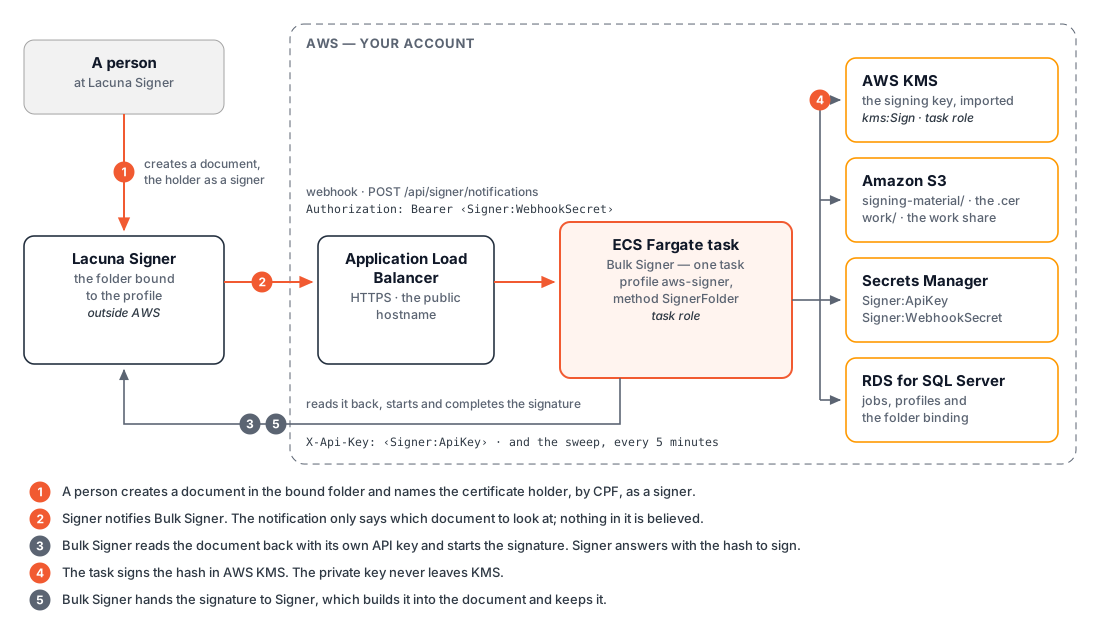
Connections
Compared with a deployment that signs files only, three connections are added. None of them is an AWS resource.
| Direction | Content | Credential |
|---|---|---|
| Signer → load balancer → task | The webhook: POST https://<host>/api/signer/notifications | Signer:WebhookSecret, sent as Authorization: Bearer |
| Task → Signer | The sweep, the read-back of each document, and the start and completion of each signature | Signer:ApiKey, sent as X-Api-Key |
| Task → KMS | kms:Sign, one call per signed document | The task role |
Differences from file signing
| Aspect | Behaviour with the SignerFolder method |
|---|---|
| Document content | No file passes through Bulk Signer. Signer sends the hash to sign, the task signs it in KMS, and Signer builds the signature into the document and stores it. Nothing enters a watched folder and nothing is written to work/output/. The signed document is downloaded from Signer. |
| Identification of the holder | Signer matches the participant of the document to the CPF contained in the profile's certificate. The certificate must therefore be an ICP-Brasil e-CPF or e-CNPJ (which contains the CPF of its responsible person). |
| Signature format | Signer selects the format: PAdES for a PDF, XAdES for XML, CAdES for any other type. The profile's own format setting is ignored. |
Function of Signer:WebhookSecret in performance
Discovery mechanisms
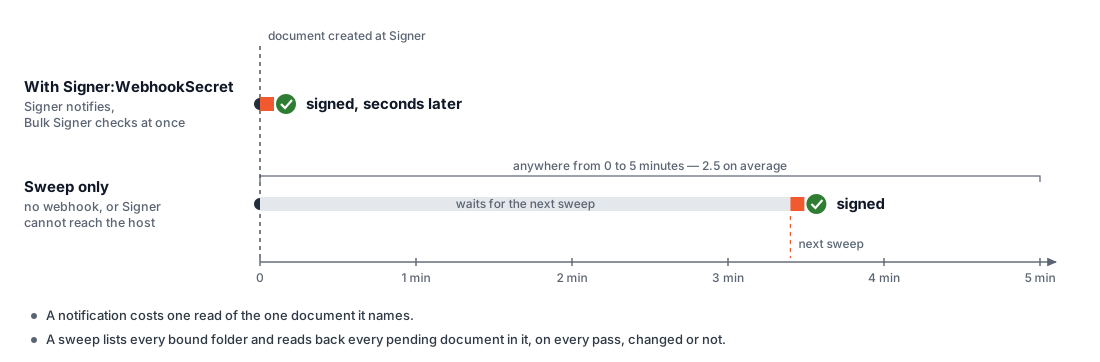
Bulk Signer has two mechanisms for detecting a document that awaits its signature:
| Mechanism | Operation | Availability |
|---|---|---|
| Sweep | Every Signer:FolderSweepIntervalSeconds (default: 300 seconds), the task lists the pending documents of every bound folder and reads each one back from Signer. | Always active. Requires only Signer:ApiKey. |
| Notification | Signer calls POST /api/signer/notifications when a document is created, signed or approved. The task queues a check for the document named in the call, responds immediately, and reads that document back. | Only when Signer:WebhookSecret is set. Without it, the route returns 404. |
Effect of the setting
| Aspect | Sweep only | With Signer:WebhookSecret |
|---|---|---|
| Time until a document is detected | Up to the sweep interval: 0 to 5 minutes by default, 2.5 minutes on average. | Seconds. |
| Calls to the Signer API | On every pass, one listing per bound folder plus one read per pending document in it, regardless of whether anything changed. | One read per notified document. |
| Flows with several participants | Each hand-over to the holder waits for a sweep. | The notification of the step preceding the holder's is the event through which the holder's turn is detected, in seconds. |
The detection time can also be reduced, without the webhook, by lowering
Signer:FolderSweepIntervalSeconds. Its minimum is 60 seconds, and every pass repeats the same listing
and the same reads. At the minimum, the number of calls to Signer is five times that of the default, and
a document still waits up to one minute. With the webhook, the number of calls is proportional to the
number of events, and the sweep interval can remain at the default or be increased.
Scope
| Property | Specification |
|---|---|
| Signature duration | Not affected. The setting changes the time until a document is detected, not the time required to sign it. In the homologation environment, a job took 1.2 seconds, queue wait included. Throughput is determined by Pipeline:MaxConcurrency and by the KMS quota. |
| Delivery guarantee | Provided by the sweep, not by the notification. If Signer cannot reach the load balancer, or a delivery is lost, the document is signed at the next sweep. A document is delayed, never lost. |
| Trust in the notification | None. A notification identifies which document to read; no other content of it is used. The document is read back from Signer with Signer:ApiKey before a job is created. |
Security properties
The route is public, and the secret is the only element that distinguishes a call from Signer from any other call.
| Property | Specification |
|---|---|
| Minimum length | 32 characters. Leading or trailing whitespace is refused at boot. |
| Comparison | In fixed time. |
| Call without the secret | 401. |
| Effect of a forged call that presents the secret | At most, the task reads one document from Signer. |
Prerequisites
| Requirement | Specification |
|---|---|
| Tools | The AWS CLI v2, authenticated (aws sts get-caller-identity must succeed), and a bash shell for the commands on this page (on Windows, Git Bash from Git for Windows). Docker, to copy the image (step 3). PowerShell 7 and OpenSSL 3.x (included with Git for Windows), for the key import (step 2). jq, which ships with neither Windows nor Git for Windows (winget install jqlang.jq; brew install jq on macOS; apt install jq on Linux), to read the responses in steps 7 to 10 and to push the image from Docker Desktop for Windows. |
| The template | bulksigner-ecs-fargate.yaml, saved in the working directory. It is also in the product repository, under docs/samples/. |
| IAM permissions | Permission to create a CloudFormation stack with named IAM resources (CAPABILITY_NAMED_IAM) and the resources it creates: S3, EC2 security groups, RDS, Secrets Manager, IAM (iam:CreateRole, iam:PutRolePolicy, iam:PassRole), ACM, Elastic Load Balancing, CloudWatch Logs, ECS and Lambda; plus KMS for step 2 and ECR for step 3. The PowerUserAccess policy alone is insufficient: it is denied iam:CreateRole. |
| Registry credentials | The credentials Lacuna issued for the container image. See Obtaining the product. |
| Licence | The PKI SDK licence. |
| DNS | A hostname that Signer can reach over the internet, and write access to the DNS zone that is authoritative for it. Confirm the delegation with dig +short NS example.com: a domain can have a Route 53 hosted zone in the account while being delegated to another provider. |
| Lacuna Signer organization | An organization on a Lacuna Signer instance, and a user with the organization administrator role. That role is required to register the webhook. |
| Lacuna Signer API key | An API key of that organization (step 1.2). |
| Signing material | The PFX file of an ICP-Brasil e-CPF or e-CNPJ certificate, with an RSA 2048, 3072 or 4096 key, and its password. A certificate that contains no CPF is refused when the profile is created. |
| Holder identification | The CPF contained in the certificate and an e-mail address of the holder. Documents must name the holder as a participant with exactly that CPF. |
| Microsoft Entra ID (optional) | Only for operator sign-in with a Microsoft account (step 4.2): a tenant, the Microsoft.Graph.Applications PowerShell module, and an account with the Cloud Application Administrator role or higher. |
Shell variables
All commands on this page run in one shell session, initialised with the following variables:
export MSYS_NO_PATHCONV=1             # Git Bash only; see the note below
REGION=sa-east-1
ACCOUNT=$(aws sts get-caller-identity --query Account --output text)
NAME=bulksigner                       # the stack name and the prefix of every resource
BUCKET=$NAME-$ACCOUNT                 # created by the stack; bucket names are global
HOST=bulksigner.example.com           # the public hostname
SIGNER=https://<Lacuna Signer address>
PROFILE=aws-signer                    # the profile that signs in the Signer folder
| Variable | Content |
|---|---|
REGION | The AWS Region of every resource. |
ACCOUNT | The AWS account ID of the authenticated identity. |
NAME | The stack name, and the prefix of every resource name. From 2 to 21 lowercase letters, digits and hyphens. |
BUCKET | The name of the bucket the stack creates. It includes the account ID because S3 bucket names are globally unique. |
HOST | The public hostname of the deployment. Signer calls it. |
SIGNER | The address of the Lacuna Signer API (step 1.1), without a trailing slash. |
PROFILE | The name of the signing profile bound to the Signer folder. It must not be default. |
MSYS_NO_PATHCONV | Turns off Git Bash's path conversion. Without it, an argument that starts with / is rewritten as a Windows path before it reaches the AWS CLI: aws logs tail /ecs/$NAME reads a log group named C:/Program Files/Git/ecs/…. In other shells the line has no effect. |
Network placement
The stack uses the default VPC of the Region and its default subnets, one per Availability Zone. The task receives a public IP address for its outbound calls (ECR, KMS, S3, Secrets Manager, Lacuna Signer), and its security group admits inbound traffic from the load balancer only. In private subnets, the task requires a NAT gateway: Lacuna Signer is not an AWS service and cannot be reached through a VPC endpoint. The template does not support private subnets.
1. Lacuna Signer preparation
The following four items are defined in Lacuna Signer before any AWS resource is created.
1.1 API address
SIGNER is the address on which the Signer instance's API responds, which is not necessarily the address
of the product's home page. Without a key, the API returns 401:
curl -s -o /dev/null -w '%{http_code}\n' $SIGNER/api/documents # 401
1.2 API key
Create an application in the organization and generate its key, as specified in step 1 of Getting started with the Signer API.
| Property | Specification |
|---|---|
| Access to the Applications menu | Restricted to the instance's system administrator. Without that access, request a key of the organization from the administrator of the Signer instance. |
| Format | <application>|<secret>. The application part may contain spaces. |
| Display | The key is displayed once, when it is created. |
| Scope | The organization in which it was created. The folder selector in step 8 lists only that organization's folders, and the task reads documents with this key. |
| Required access | A role that grants access to the folders and documents of the organization. |
1.3 Folder
In Folders, select the organization and create a folder with the New folder icon.
| Rule | Specification |
|---|---|
| Binding | One-to-one. Two profiles cannot share a folder. |
| Scope | The folder itself. A document in one of its subfolders is not signed. |
The screenshots on this page use a folder named AWSTest.
1.4 PDF signature policy
Whether a PDF signed with an ICP-Brasil certificate receives the ICP-Brasil policy (AD-RB) or a basic
PAdES signature is determined by Signer's UseBrazilianPdfSigningPolicies setting, not by Bulk Signer.
The setting belongs to the Signer instance:
| Signer instance | Where the setting is defined |
|---|---|
| On-premises | In the instance's settings. |
| Lacuna's cloud | By Lacuna. Request confirmation of the value in effect. |
Define the policy before the first document is signed.
2. The signing key and the certificate
A PFX file contains two items with different destinations:
| Item | Destination | Property |
|---|---|---|
| Private key | AWS KMS | KMS never returns it. |
| Certificate | A .cer file, which the stack checks against the key and uploads to the S3 bucket | Public material. |
When the profile is opened, Bulk Signer reads both and refuses the pair if the public keys differ.
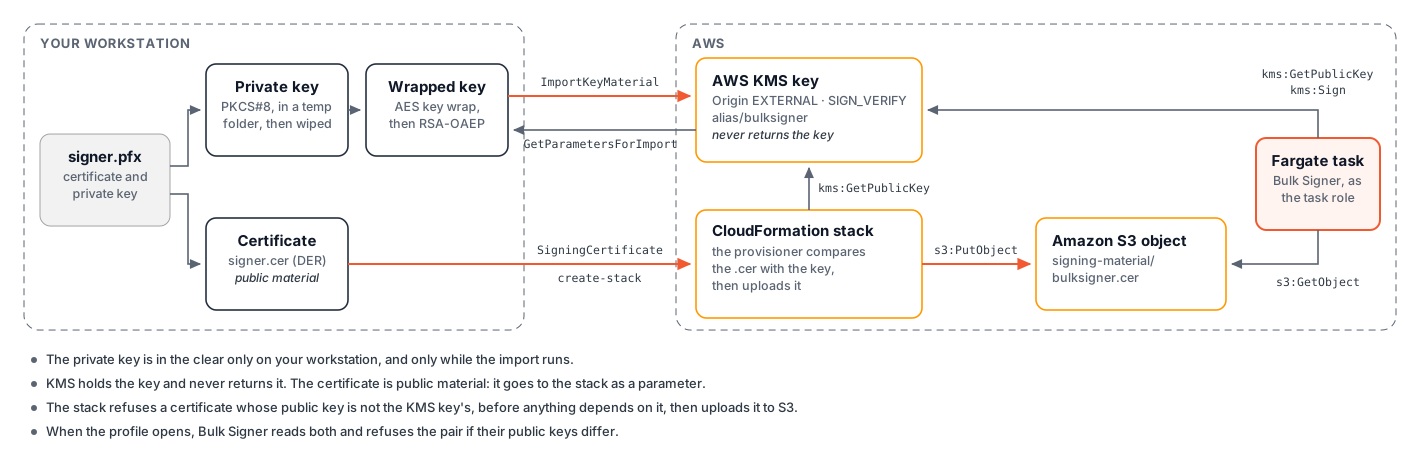
2.1 Import with the script
Import-PfxToKms.ps1 performs the complete import and
prompts for the PFX password. The bucket does not exist yet, so the certificate is written to a file:
pwsh ./Import-PfxToKms.ps1 -PfxPath ./signer.pfx -Region $REGION -Alias $NAME \
  -CerPath ./signer.cer -SignerPrincipalArn arn:aws:iam::$ACCOUNT:role/$NAME-task
| Parameter | Value | Description |
|---|---|---|
-PfxPath | ./signer.pfx | The PFX file holding the key and the certificate. |
-Region | $REGION | The AWS Region in which the key is created. |
-Alias | $NAME | The KMS alias. Steps 5 and 8 reference it as alias/<name>. The script stops if the alias already exists. |
-CerPath | ./signer.cer | The certificate, which step 5 passes to the stack. |
-SignerPrincipalArn | The task role ARN | The principal exempted from the key policy's kms:Sign deny. The stack creates the role, with exactly this name, in step 5; an ARN can be referenced before the role exists. |
Key policy. The key is created with the default KMS key policy plus an explicit deny of kms:Sign
to every other principal. An account administrator therefore cannot sign as the certificate holder
without first changing the key policy, and CloudTrail records that change.
2.2 Manual import
The following procedure is equivalent to the script and exposes each call. Run it in an empty directory, on a machine trusted to hold the PFX.
Import with the AWS CLI and OpenSSL
1. Extract the certificate and the private key. Each command prompts for the PFX password. A PFX
protected with legacy algorithms requires -legacy on both commands.
openssl pkcs12 -in signer.pfx -clcerts -nokeys | openssl x509 -outform DER -out signer.cer
openssl pkcs12 -in signer.pfx -nocerts -nodes | openssl pkcs8 -topk8 -nocrypt -outform DER -out private-key.der
openssl x509 -inform DER -in signer.cer -noout -text | grep 'Public-Key'       # 2048, 3072 or 4096
signer.cer is public material. private-key.der is the private key in plaintext and exists until
item 7.
2. Create a KMS key without key material. --origin EXTERNAL creates a key that awaits an import.
The key spec must match the size reported in item 1. The policy is the default KMS key policy plus the
deny that reserves kms:Sign for the task role:
cat > key-policy.json <<EOF
{
  "Version": "2012-10-17",
  "Statement": [
    { "Sid": "EnableIamUserPermissions", "Effect": "Allow",
      "Principal": { "AWS": "arn:aws:iam::$ACCOUNT:root" }, "Action": "kms:*", "Resource": "*" },
    { "Sid": "OnlyNamedPrincipalsMaySign", "Effect": "Deny",
      "Principal": "*", "Action": "kms:Sign", "Resource": "*",
      "Condition": { "StringNotEquals": { "aws:PrincipalArn": ["arn:aws:iam::$ACCOUNT:role/$NAME-task"] } } }
  ]
}
EOF
KEY_ID=$(aws kms create-key --region $REGION --origin EXTERNAL --key-spec RSA_2048 --key-usage SIGN_VERIFY \
  --description "Bulk Signer signing key" --policy file://key-policy.json --query KeyMetadata.KeyId --output text)
aws kms create-alias --region $REGION --alias-name alias/$NAME --target-key-id $KEY_ID
3. Obtain the import parameters. KMS returns a single-use RSA public key (the wrapping key) and an import token, both valid for 24 hours:
aws kms get-parameters-for-import --region $REGION --key-id $KEY_ID \
  --wrapping-algorithm RSA_AES_KEY_WRAP_SHA_256 --wrapping-key-spec RSA_4096 > import-params.json
jq -r .PublicKey   import-params.json | base64 -d > wrapping-public-key.der
jq -r .ImportToken import-params.json | base64 -d > import-token.bin
4. Wrap the private key. An RSA private key exceeds the size that can be encrypted directly under the
wrapping key, so KMS requires a hybrid algorithm, RSA_AES_KEY_WRAP_SHA_256. The private key is wrapped
under a random AES-256 key, the AES key is encrypted under the wrapping key, and the import file is the
concatenation of the two, with the encrypted AES key first.
openssl rand -out aes-key.bin 32
openssl enc -id-aes256-wrap-pad -K "$(xxd -p -c 64 aes-key.bin)" -iv A65959A6 \
  -in private-key.der -out key-material-wrapped.bin
openssl pkeyutl -encrypt -in aes-key.bin -out aes-key-wrapped.bin -inkey wrapping-public-key.der -keyform DER -pubin \
  -pkeyopt rsa_padding_mode:oaep -pkeyopt rsa_oaep_md:sha256 -pkeyopt rsa_mgf1_md:sha256
cat aes-key-wrapped.bin key-material-wrapped.bin > encrypted-key-material.bin
5. Import the key material.
aws kms import-key-material --region $REGION --key-id $KEY_ID \
  --encrypted-key-material fileb://encrypted-key-material.bin --import-token fileb://import-token.bin \
  --expiration-model KEY_MATERIAL_DOES_NOT_EXPIRE
6. Compare the key with the certificate. The two output lines must be identical. This is the comparison Bulk Signer performs when the profile is opened:
aws kms get-public-key --region $REGION --key-id $KEY_ID --query PublicKey --output text | base64 -d \
  | openssl rsa -pubin -inform DER -noout -modulus
openssl x509 -inform DER -in signer.cer -noout -modulus
7. Remove the private key. Keep signer.cer for step 5.
rm -f private-key.der aes-key.bin key-material-wrapped.bin aes-key-wrapped.bin encrypted-key-material.bin import-token.bin
rm removes the directory entries only. The script overwrites each file with zeros before deleting it.
2.3 Verification
aws kms describe-key --region $REGION --key-id alias/$NAME \
  --query 'KeyMetadata.{State:KeyState,Usage:KeyUsage,Spec:KeySpec,Origin:Origin}'
| Item | Expected value |
|---|---|
State | Enabled |
Usage | SIGN_VERIFY |
Spec | RSA_2048, RSA_3072 or RSA_4096, according to the key |
Origin | EXTERNAL |
signer.cer | Exists in the working directory. The stack compares it with the key again in step 5. |
KMS never returns the private key, but the key existed outside an HSM before the import. Retain exactly one copy of the PFX in offline backup, which is the only means of importing the key again, and delete all other copies. For an ICP-Brasil A3 certificate, whose key is required to remain in certified hardware, resolve the compliance question before proceeding.
Key generated in KMS. A key created inside KMS instead requires a CSR signed by KMS and a certificate issued for it. That procedure is documented in Certificates.
3. The image
Copy the tag Lacuna specified for installation into an ECR repository in the account. Along with the registry credentials, Lacuna provides three values:
| Variable | Content |
|---|---|
REGISTRY | The registry host only, for example <name>.azurecr.io. It is the argument of docker login, which does not accept a path. |
REPOSITORY | The image's path inside the registry, for example lacuna/bulksigner. |
VERSION | The version to install, for example 2.20.0. Use an explicit version, not latest. |
REGISTRY=<Lacuna registry host>
REPOSITORY=<image path in the registry>
VERSION=<version>
IMAGE=$ACCOUNT.dkr.ecr.$REGION.amazonaws.com/bulksigner:$VERSION

aws ecr create-repository --repository-name bulksigner --region $REGION \
  --image-tag-mutability IMMUTABLE --image-scanning-configuration scanOnPush=true

docker login $REGISTRY --username <registry-username>     # prompts for the token
docker pull --platform linux/amd64 $REGISTRY/$REPOSITORY:$VERSION
docker tag $REGISTRY/$REPOSITORY:$VERSION $IMAGE
Push the image to ECR. On Linux and macOS:
aws ecr get-login-password --region $REGION \
  | docker login --username AWS --password-stdin $ACCOUNT.dkr.ecr.$REGION.amazonaws.com
docker push $IMAGE
On Docker Desktop for Windows, docker login to ECR fails with
error storing credentials … The stub received bad data: the ECR token exceeds the size Windows
Credential Manager accepts. An empty --config directory does not help, because Docker Desktop keeps
using Credential Manager. Write the token straight into the config.json of a temporary directory and
push with it:
mkdir -p .docker-ecr
aws ecr get-authorization-token --region $REGION --query 'authorizationData[0].authorizationToken' --output text \
  | jq -R --arg r "$ACCOUNT.dkr.ecr.$REGION.amazonaws.com" '{auths: {($r): {auth: .}}}' > .docker-ecr/config.json
docker --config .docker-ecr push $IMAGE
rm -rf .docker-ecr
The directory holds an ECR access token valid for 12 hours; the rm removes it. Confirm the push:
aws ecr describe-images --region $REGION --repository-name bulksigner --query 'imageDetails[].imageTags' --output text
4. Secrets entered by hand
4.1 Secrets
The deployment reads six secrets. The stack generates three of them; the values of the other three are issued outside AWS and are entered by hand before the stack is created. The template receives only their ARNs, never their values.
| Secret | Content | Created by | Injected as |
|---|---|---|---|
$NAME/sql-app | JSON with username, password and connectionString | The stack | ConnectionStrings__Default (key connectionString) |
$NAME/auth-api-key | A random 48-character key: the REST API's X-API-Key and the dashboard's sign-in key | The stack | Auth__ApiKey |
$NAME/signer-webhook-secret | The token Signer presents on a notification: 48 characters, without punctuation | The stack | Signer__WebhookSecret |
$NAME/pki-sdk-license | The PKI SDK licence | By hand, below | Signing__PkiSdkLicense |
$NAME/signer-api-key | The Lacuna Signer API key from step 1.2, in the format <application>|<secret> | By hand, below | Signer__ApiKey |
$NAME/entra-client-secret | The client secret of the Microsoft Entra ID app registration (optional) | By hand, step 4.2 | Auth__EntraId__ClientSecret |
Create the two required secrets from a prompt that does not echo input, and keep their ARNs for step 5. Paste the Signer API key exactly as Signer displayed it, including any spaces in the application part:
read -rsp 'PKI SDK licence: ' VALUE; echo
PKI_ARN=$(aws secretsmanager create-secret --region $REGION --name $NAME/pki-sdk-license \
  --secret-string "$VALUE" --query ARN --output text)
read -rsp 'Lacuna Signer API key: ' VALUE; echo
SIGNER_KEY_ARN=$(aws secretsmanager create-secret --region $REGION --name $NAME/signer-api-key \
  --secret-string "$VALUE" --query ARN --output text)
unset VALUE
The secrets can also be created in the console (Other type of secret → Plaintext, containing the bare
value only); then copy each ARN into PKI_ARN and SIGNER_KEY_ARN.
4.2 Microsoft Entra ID sign-in (optional)
By default the dashboard's sign-in page asks for the $NAME/auth-api-key key. With an Auth:EntraId
section it offers Sign in with Microsoft instead, and two app roles control access: Administrator
for the operator dashboard and Approver for the approver pages
(Configuration). The REST API's
X-API-Key does not change. To sign in to the dashboard with the API key, skip this step.
Sessions created by the API-key sign-in stop working once the Auth:EntraId section is present.
Configured at this point, Entra ID is part of the stack's first deployment, and the profile in step 8 is
created with the Microsoft account. To add it to a running stack, see Operations.
1. Create the app registration. Give the environment its own registration, not one shared with
another environment. New-BulkSignerEntraApp.ps1
creates a single-tenant registration with the redirect URI https://$HOST/signin-oidc, the
Administrator and Approver app roles, the email claim, and an enterprise application with
Assignment required:
pwsh ./New-BulkSignerEntraApp.ps1 -BaseUrl https://$HOST -DisplayName "Lacuna Bulk Signer (AWS)"
The script refuses a display name that already exists in the tenant. At the end it prints, once, the
Auth__EntraId__TenantId, Auth__EntraId__ClientId and Auth__EntraId__ClientSecret block.
2. Store the values. The client secret goes into Secrets Manager from a prompt that does not echo; the tenant and the client are not secrets:
read -rsp 'Client secret: ' VALUE; echo
ENTRA_ARN=$(aws secretsmanager create-secret --region $REGION --name $NAME/entra-client-secret \
  --secret-string "$VALUE" --query ARN --output text)
unset VALUE
TENANT_ID=<the Auth__EntraId__TenantId value>
CLIENT_ID=<the Auth__EntraId__ClientId value>
Clear the console afterwards.
3. Assign people. In the Entra admin center, under Enterprise applications → the application → Users and groups, assign the Administrator app role to each operator. An account with no assignment cannot sign in, and an account that authenticates with neither role is refused.
| Item | Description |
|---|---|
| Dependence on forwarded headers | Sign-in builds its redirect URI from the scheme Bulk Signer sees. The stack sets Hosting:ForwardedHeaders; without it the URI would be http://…/signin-oidc, and Microsoft refuses it with AADSTS50011. |
| Client secret expiry | The script's default lifetime is twelve months. An expired secret fails only at sign-in time, with an AADSTS error. Rotate it into the same secret and force a new deployment (Operations). |
5. The stack
5.1 What the stack creates
One CloudFormation stack, named $NAME, creates the whole AWS infrastructure of the deployment. Every
resource name starts with $NAME.
| Resource | Name | Specification |
|---|---|---|
| S3 bucket | $NAME-<account> | All public access blocked; incomplete multipart uploads aborted after one day; the inputs/default/ folder; the certificate at signing-material/$NAME.cer. |
| Security groups | $NAME-alb, $NAME-task, $NAME-db | TCP 443 and 80 from 0.0.0.0/0 into the load balancer; TCP 8080 from the load balancer into the task; TCP 1433 from the task into the database. |
| RDS for SQL Server | $NAME | sqlserver-ex 16.00 (SQL Server 2022), db.t3.small, 20 GiB gp3, encrypted, not publicly accessible, seven-day backups. The master user bsadmin has a password managed by RDS in Secrets Manager. |
| Database and login | BulkSigner, bulksigner | Created by a one-off Fargate task that runs sqlcmd (image mcr.microsoft.com/mssql-tools) as the master user: the database with READ_COMMITTED_SNAPSHOT on, and a login that holds db_datareader, db_datawriter and db_ddladmin, not db_owner. The stack fails if the task exits with a code other than 0. |
| Secrets | $NAME/sql-app, $NAME/auth-api-key, $NAME/signer-webhook-secret | Generated by Secrets Manager (step 4.1). The connection string carries TrustServerCertificate=True, because the Bulk Signer image does not trust the Amazon RDS certificate authority (step 5 of Amazon ECS Fargate). |
| IAM roles | $NAME-exec, $NAME-task | $NAME-exec, assumed by Amazon ECS: AmazonECSTaskExecutionRolePolicy plus secretsmanager:GetSecretValue on the six secrets and on the RDS master secret (the latter for the database task only). $NAME-task, assumed by Bulk Signer: kms:DescribeKey, kms:GetPublicKey and kms:Sign on the key from step 2, s3:ListBucket on the bucket, and reading, writing and deleting its objects. Both trust ecs-tasks.amazonaws.com in the account only. |
| ACM certificate | — | For $HOST, with DNS validation (step 5.3). Not created when an existing certificate ARN is given. |
| Load balancer and target group | $NAME | Internet-facing, idle timeout 300 seconds, invalid header fields dropped. HTTPS listener with ELBSecurityPolicy-TLS13-1-2-2021-06; HTTP listener that redirects to HTTPS with 301. Target group on port 8080, health check /api/ready every 30 seconds, deregistration delay 30 seconds. The purpose of each setting is specified in step 7 of Amazon ECS Fargate. |
| Log groups | /ecs/$NAME, /aws/lambda/$NAME-provisioner | 30-day retention. |
| Cluster, task definition and service | $NAME, $NAME, bulksigner | Fargate, 1 vCPU and 2 GB, X86_64, port 8080, stopTimeout 60. One task, with the deployment settings of step 5.5. |
| Lambda function | $NAME-provisioner | Runs the four operations CloudFormation has no resource type for: it finds the default VPC, writes the inputs/default/ folder, checks the certificate against the KMS key and uploads it, and creates the database. It is not in the VPC and calls AWS APIs only. |
The webhook is a call from Signer to the load balancer. If the $NAME-alb group is restricted to
specific source addresses, the addresses from which the Signer instance calls must also be admitted;
obtain them from the operator of the instance. If Signer cannot be admitted, omit the webhook. The sweep
alone signs every document, with the delay specified in
Function of Signer:WebhookSecret in performance.
The bucket uses three prefixes, which must not nest:
| Prefix | Content | Written by | Used by the Signer folder |
|---|---|---|---|
signing-material/ | The signing certificate (.cer) | The stack, from step 2's signer.cer | Yes. Read when the profile is opened. |
work/ | The work share | Bulk Signer, at boot | No. Bulk Signer nevertheless does not start without a work share. |
inputs/default/ | A watched folder, for files signed by the default profile | The stack | No. |
Versioning and Object Lock must remain disabled. The behavioural differences of an S3 work share are documented in Configuration.
5.2 Parameters
| Parameter | Value on this page | Description |
|---|---|---|
Prefix | $NAME | The prefix of every resource name. The task role is <Prefix>-task, the role named in step 2. Default: bulksigner. |
HostName | $HOST | The public hostname. |
ImageUri | $IMAGE | The image in ECR, from step 3. |
KmsKeyAlias | alias/$NAME | The alias from step 2. Default: alias/bulksigner. |
SigningCertificate | The base64 of signer.cer | The certificate from step 2, on one line. The stack refuses it if its public key is not the KMS key's, before any other resource depends on it, and uploads it to the bucket. |
PkiSdkLicenseSecretArn | $PKI_ARN | Step 4.1. |
SignerEndpoint | $SIGNER | The Signer API address, without a trailing slash. Empty for a deployment that signs files only: no Signer__* settings and no webhook secret. |
SignerApiKeySecretArn | $SIGNER_KEY_ARN | Step 4.1. Required with SignerEndpoint. |
CertificateArn | Empty | An issued ACM certificate for $HOST in $REGION. Empty: the stack requests one with DNS validation (step 5.3). |
Route53HostedZoneId | Empty | Only when the stack requests the certificate and the zone authoritative for $HOST is a Route 53 hosted zone in the account: the stack then creates the validation record itself. |
EntraTenantId, EntraClientId, EntraClientSecretArn | $TENANT_ID, $CLIENT_ID, $ENTRA_ARN | Step 4.2, optional. All three or none. |
AppEnvironment, TrustLacunaTestRoot | Production, false | For a homologation environment that signs with Lacuna's test certificates: Staging and true (Configuration). The stack refuses true with Production. |
DatabaseEngine, DatabaseEngineVersion, DatabaseInstanceClass | sqlserver-ex, 16.00, db.t3.small | Express edition is sufficient for a homologation environment; production environments require sqlserver-web or sqlserver-se. |
5.3 Creation
aws cloudformation create-stack --region $REGION --stack-name $NAME \
  --template-body file://bulksigner-ecs-fargate.yaml --capabilities CAPABILITY_NAMED_IAM \
  --parameters ParameterKey=Prefix,ParameterValue=$NAME ParameterKey=HostName,ParameterValue=$HOST \
    ParameterKey=ImageUri,ParameterValue=$IMAGE ParameterKey=KmsKeyAlias,ParameterValue=alias/$NAME \
    ParameterKey=SigningCertificate,ParameterValue=$(openssl base64 -A -in signer.cer) \
    ParameterKey=PkiSdkLicenseSecretArn,ParameterValue=$PKI_ARN \
    ParameterKey=SignerEndpoint,ParameterValue=$SIGNER ParameterKey=SignerApiKeySecretArn,ParameterValue=$SIGNER_KEY_ARN \
    ${TENANT_ID:+ParameterKey=EntraTenantId,ParameterValue=$TENANT_ID ParameterKey=EntraClientId,ParameterValue=$CLIENT_ID ParameterKey=EntraClientSecretArn,ParameterValue=$ENTRA_ARN}
The last line adds the Entra ID parameters only when TENANT_ID is set (step 4.2). The stack can also be
created in the console, under CloudFormation → Create stack → With new resources → Upload a template
file, with the same parameters.
Certificate validation. When CertificateArn is empty, the stack waits for the ACM certificate to be
validated, and stops there until the validation record exists. About a minute after creation starts, the
record appears in the stack's events:
aws cloudformation describe-stack-events --region $REGION --stack-name $NAME \
  --query "StackEvents[?LogicalResourceId=='Certificate' && contains(ResourceStatusReason || '','CNAME')].ResourceStatusReason" \
  --output text
Create the returned CNAME record (Name and Value) in the authoritative zone. The stack continues once
ACM has validated it, usually within minutes. With Route53HostedZoneId, this step is not needed.
5.4 Completion
Wait for the stack, then read its outputs:
aws cloudformation wait stack-create-complete --region $REGION --stack-name $NAME
aws cloudformation describe-stacks --region $REGION --stack-name $NAME --query 'Stacks[0].Outputs' --output table
Creation takes about 20 minutes, most of it for the RDS instance; a certificate validation adds the time until the record exists. The first boot of the task applies the database migrations; the stack is complete once the service is stable.
| Output | Content |
|---|---|
Url | https://$HOST/ |
DnsRecord | The CNAME record to create in step 6. |
LoadBalancerDnsName | The load balancer's DNS name. |
BucketName, KmsKeyArn | The bucket and the KMS key, as used in step 8. |
AuthApiKeySecretArn, SignerWebhookSecretArn | The generated secrets read in steps 7, 8 and 9. |
WebhookUrl | The URL registered in Signer in step 9. |
LogGroupName | /ecs/$NAME. |
If the creation fails, CloudFormation rolls it back and deletes what it created, the bucket included. The cause is in the first failed event:
aws cloudformation describe-stack-events --region $REGION --stack-name $NAME \
  --query "StackEvents[?ends_with(ResourceStatus,'FAILED')].[LogicalResourceId,ResourceStatusReason]" --output text
See Error reference. After a rollback, delete the stack
(aws cloudformation delete-stack --region $REGION --stack-name $NAME) before creating it again.
5.5 The service
| Setting | Value | Requirement |
|---|---|---|
minimumHealthyPercent, maximumPercent | 0, 100 | Every deployment stops the running task before starting the new one. |
| Desired count | 1 | Must not be increased. Auto scaling must not be attached. |
deploymentCircuitBreaker | enable=true, rollback=false | A failed deployment stops instead of rolling back, which would start a second task. |
| Availability Zone rebalancing | Off | Rebalancing starts a task before stopping one. |
| Health check grace period | 300 seconds | The first boot applies the migrations before /api/ready answers. |
5.6 Bulk Signer configuration
The stack writes the container's environment and secrets. A __ in an environment variable name
corresponds to : in the configuration key.
Lacuna Signer connection. One host connects to one Signer organization, and every profile that uses
the SignerFolder method uses these settings
(Configuration).
| Environment variable | Value in this deployment | Required | Description |
|---|---|---|---|
Signer__Endpoint | The SignerEndpoint parameter | Yes | The address of the Signer API. |
Signer__ApiKey | Secret $NAME/signer-api-key | Yes | Sent as X-Api-Key on every call to Signer: the sweep, the read-back of each document, and the start and completion of each signature. It also determines the organization whose folders the profile form lists. |
Signer__WebhookSecret | Secret $NAME/signer-webhook-secret | No | Enables POST /api/signer/notifications and is the Bearer token Signer must present on it. Without it, the route returns 404 and documents are detected by the sweep only (see Function of Signer:WebhookSecret in performance). |
Signer__FolderSweepIntervalSeconds | 300 (the default) | No | The interval between listings of every bound folder, from 60 to 86400 seconds. |
The following rules apply to the Signer keys:
- Joint requirement. Setting any key under
Signer:, including the webhook secret alone, makesSigner:EndpointandSigner:ApiKeymandatory at boot. The template sets all of them or none. - Keys not used by this method.
Signer:PollIntervalSeconds,Signer:TimeoutHoursandSigner:MaxConsecutiveApiFailuresapply to theLacunaSignermethod only.
Other settings. The remaining keys are those of the base deployment and are specified in the Configuration reference of Amazon ECS Fargate. The following points are specific to this deployment:
| Setting | Relevance to the Lacuna Signer integration |
|---|---|
Signing:Certificate:* | The seed (initial load) of the default signing profile, applied on the first boot against an empty database only. The default profile cannot use the SignerFolder method; the profile created in step 8 references the same key and the same .cer. Every credential is InstanceRole, so no profile stores a secret. |
Hosting:ForwardedHeaders:* | With forwarded headers applied, the task observes Signer's address instead of the load balancer's. The rate limit of the notification route (RateLimiting:SignerNotification, 600 calls per minute) is counted per caller address; without forwarded headers, all callers share one budget (Configuration). The stack sets the VPC's CIDR block as the known network. |
Storage:Inputs:0:* | The watched folder for files. |
6. DNS
Point the hostname at the load balancer, with the CNAME record in the DnsRecord output or, if the zone is
hosted in Route 53, an alias record. Signer calls this hostname and validates its certificate; the ACM
certificate satisfies that requirement.
7. Verification
curl -s https://$HOST/api/ready
KEY=$(aws secretsmanager get-secret-value --region $REGION --secret-id $NAME/auth-api-key --query SecretString --output text)
curl -s -H "X-API-Key: $KEY" https://$HOST/api/ready/details | jq '.checks[] | {name, ok, detail}'
In addition to the checks specified in step 9 of Amazon ECS Fargate (database,
input-folder:default, storage-bucket:…, work-share-owner, pki-license), /api/ready/details
reports the cloudhub check, with ok: true and the detail not configured (CloudHub:ApiKey), which is
the normal value on this deployment, and two checks for the Lacuna Signer integration:
| Check | Expected result at this point |
|---|---|
signer-notifications | accepted; none has arrived at this instance since it started |
signer-folder-sweep | ok: true. After the first pass: the last pass at this instance finished without a failure at … |
If signer-notifications reports not accepted (Signer:WebhookSecret is not set), the stack was created
with an empty SignerEndpoint.
The notification route can be tested without a credential:
curl -s -o /dev/null -w '%{http_code}\n' -X POST https://$HOST/api/signer/notifications
| Response | Meaning |
|---|---|
401 (signer-notification.unauthorized) | Expected. The route is enabled and requires the Bearer token. |
404 (signer-notification.not-configured) | No webhook secret is set. |
With Entra ID (step 4.2), follow the sign-in's first redirect without signing in:
curl -s -o /dev/null -w '%{redirect_url}\n' https://$HOST/api/auth/entra-login
The URL must point to login.microsoftonline.com/<tenant>/oauth2/v2.0/authorize, with the application
ID and redirect_uri=https%3A%2F%2F<host>%2Fsignin-oidc. The https scheme is the value to confirm.
8. The signing profile
The default profile receives uploads that name no profile and watched folders that are bound to no
profile, and the SignerFolder method accepts no files. The Signer folder therefore requires a
dedicated profile.
8.1 Creation
Open the dashboard at https://<host>/ and sign in: with Sign in with Microsoft, using an account
that holds the Administrator app role, if step 4.2 was applied; otherwise with the key stored in
$NAME/auth-api-key, copied to the clipboard without being displayed:
aws secretsmanager get-secret-value --region $REGION --secret-id $NAME/auth-api-key \
  --query SecretString --output text | tr -d '\r\n' | clip
Open Signing profiles → New profile (/profiles/_new).
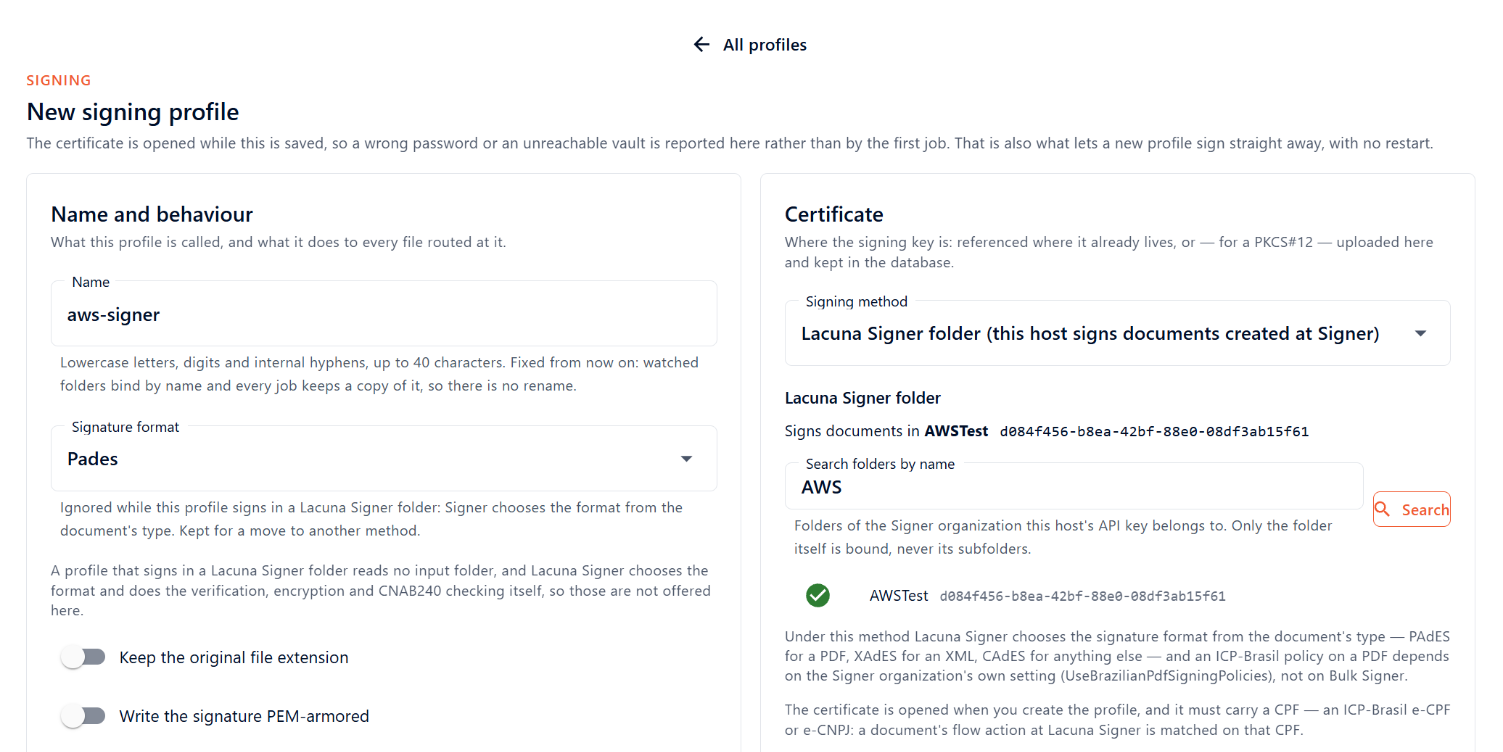
| Field | Value |
|---|---|
| Name | aws-signer (the value of $PROFILE). The name cannot be changed after creation. |
| Signing method | Lacuna Signer folder (this host signs documents created at Signer) |
| Lacuna Signer folder | The folder from step 1.3, located with the name search. The selector lists the folders of the organization to which the API key belongs and stores the folder's ID. |
| Signature format | Ignored by this method. Signer selects the format. |
| Certificate source | AwsKms |
| Where is the file? | In an Amazon S3 object |
| AWS region, KMS key, AWS credential mode | $REGION, alias/$NAME, InstanceRole |
| S3 bucket, S3 object key, S3 region, S3 credential mode | $BUCKET, signing-material/$NAME.cer, $REGION, InstanceRole |
| S3-compatible endpoint | Empty. The field is for S3-compatible storage such as MinIO. |
| Path-style bucket addressing | Off, for the same reason. |
When the method is selected, the form hides the settings Signer determines (the input folder, verification, encryption and the CNAB240 check) and saves them as disabled.
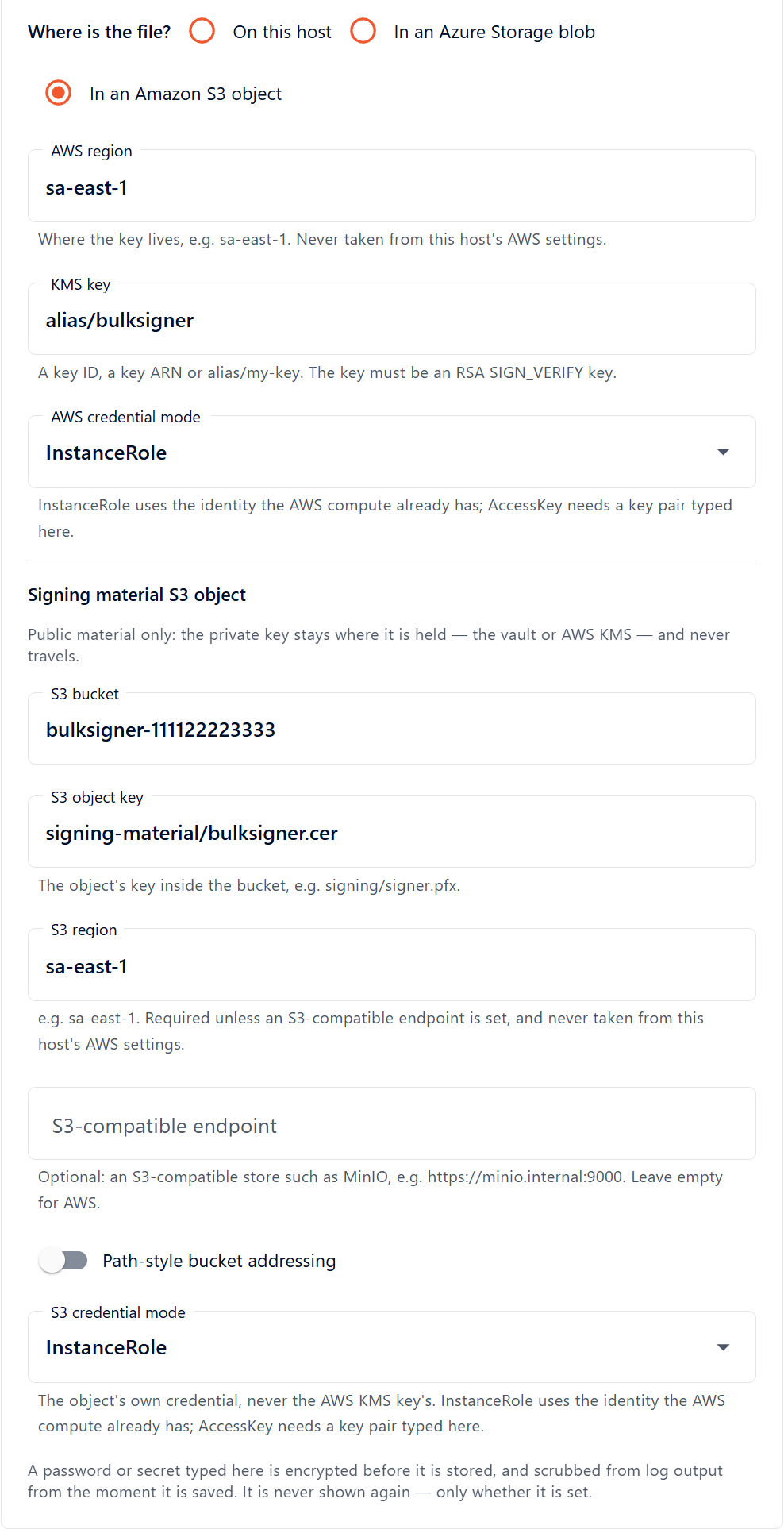
Select Create profile. The certificate is opened during the save: the task reads the .cer from
S3, requests the public key from KMS and compares the two. The save is refused, and no profile is created,
in the following cases:
| Condition | Cause |
|---|---|
| KMS key not accessible | An incorrect alias, or a task role without kms:GetPublicKey on the key. |
| Certificate without a CPF | The certificate is not an e-CPF or e-CNPJ. |
| Folder already bound | Another profile signs in the selected folder. |
A saved profile takes effect immediately. No restart is required.
8.2 Verification
curl -s -H "X-API-Key: $KEY" https://$HOST/api/profiles/$PROFILE | jq
The response must report the SignerFolder method and degraded = false. On the Signing profiles
page, the profile's state is ready.
8.3 Separate certificate for the profile
To use a certificate other than that of the default profile, import it with a different alias. The
bucket exists now, so the script can upload the certificate itself, under a different object key:
pwsh ./Import-PfxToKms.ps1 -PfxPath ./other.pfx -Region $REGION -Alias $NAME-other -S3Bucket $BUCKET -S3Key signing-material/$NAME-other.cer -SignerPrincipalArn arn:aws:iam::$ACCOUNT:role/$NAME-task
Before creating the profile, give the task role the new key in a policy of its own; otherwise the
save is refused at kms:GetPublicKey. The stack manages only the role's bulksigner-app policy, so a
policy with another name survives stack updates:
KEY_ARN=$(aws kms describe-key --region $REGION --key-id alias/$NAME-other --query KeyMetadata.Arn --output text)
aws iam put-role-policy --role-name $NAME-task --policy-name kms-$NAME-other --policy-document   "{\"Version\":\"2012-10-17\",\"Statement\":[{\"Effect\":\"Allow\",\"Action\":[\"kms:DescribeKey\",\"kms:GetPublicKey\",\"kms:Sign\"],\"Resource\":\"$KEY_ARN\"}]}"
9. The webhook in Lacuna Signer
9.1 Registration
Copy the secret to the clipboard, so that it is not displayed. The clipboard command is clip on
Windows, pbcopy on macOS and xclip -selection clipboard on Linux:
aws secretsmanager get-secret-value --region $REGION --secret-id $NAME/signer-webhook-secret \
  --query SecretString --output text | tr -d '\r\n' | clip
In Lacuna Signer, signed in as an administrator of the organization:
- Open Organizations and select the organization.
- In the Integration section, below the Webhooks card, select the + button. A new Webhook N panel opens. An organization can have several webhooks; an existing webhook of another system is not affected.
- Fill in the fields as specified below.
- Select Save, which remains disabled until the token is entered.
- Clear the clipboard.
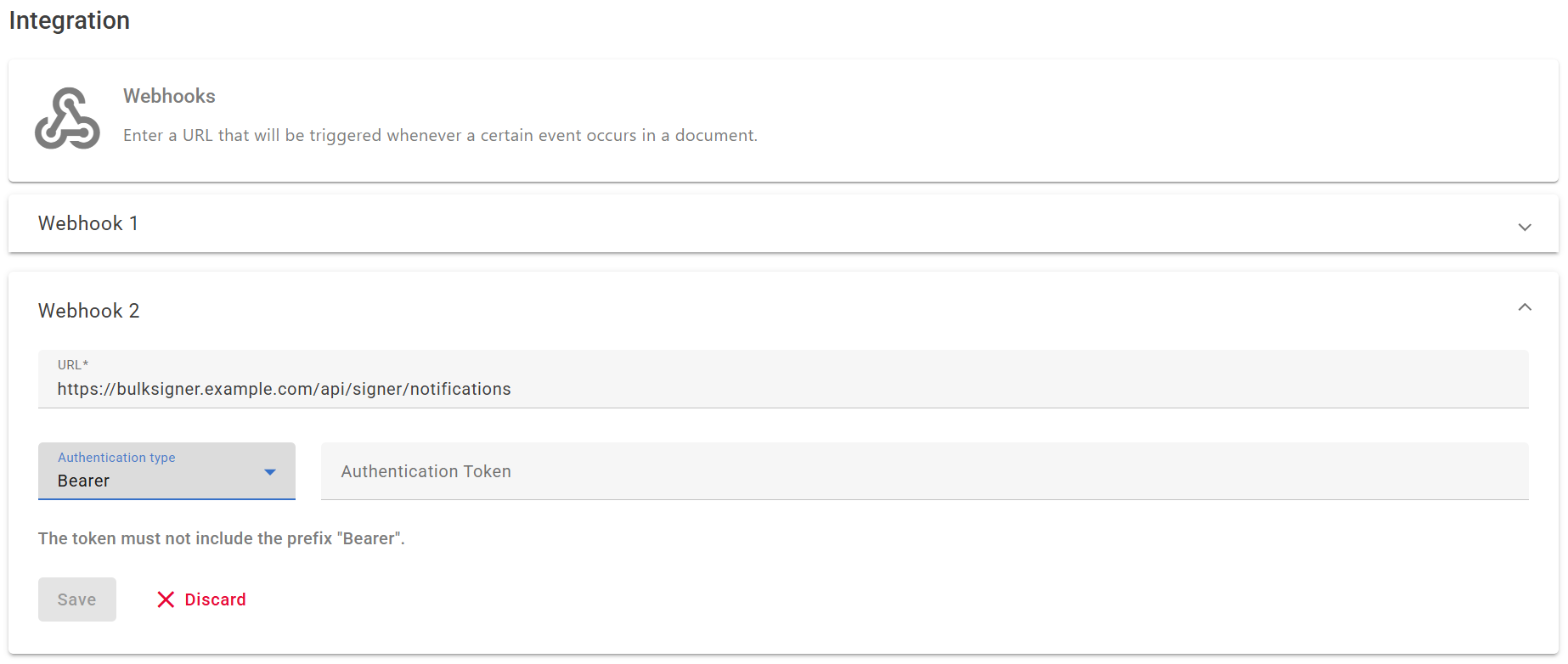
| Field | Value | Requirement |
|---|---|---|
| URL | https://<host>/api/signer/notifications | The public hostname from step 6, not the load balancer's AWS DNS name. The scheme must be https: the port-80 listener responds with a redirect, and HTTP clients commonly resend a redirected POST as a GET, which delivers no notification. |
| Authentication type | Bearer | X-Api-Key must not be used. That header is Bulk Signer's own REST credential, and a notification that presents it is refused. |
| Authentication Token | The value of $NAME/signer-webhook-secret | Without the word Bearer. Signer adds the prefix. |
The content Signer sends, and its authentication and retry behaviour, are specified in Webhooks.
9.2 Correspondence between Lacuna Signer and Bulk Signer
The complete configuration on the Signer side (steps 1 and 9):
| Item in Lacuna Signer | Location | Corresponding item in Bulk Signer |
|---|---|---|
| The application and its API key | The instance's Applications | Signer:ApiKey |
| The folder | Folders, in the organization | The profile's Lacuna Signer folder |
| The webhook URL | Organizations → Integration | The public hostname, followed by /api/signer/notifications |
| The webhook token, of type Bearer | Organizations → Integration | Signer:WebhookSecret |
UseBrazilianPdfSigningPolicies | The instance's settings | None. The setting alone determines the policy of PDF signatures. |
9.3 Delivery behaviour
| Behaviour | Specification |
|---|---|
| Event selection | Not available. Signer delivers every event of the organization to every webhook of the organization. |
| Events processed by Bulk Signer | DocumentsCreated, DocumentSigned and DocumentApproved. Every other event is answered 204, so that Signer does not retry it. |
| Retries | Signer retries a delivery that does not receive a 2xx response, up to ten times over several hours (Retries). |
| Effect of an incorrect token | Each delivery is answered 401, and the unauthorized outcome of bulksigner_signer_notifications_total increases. |
10. Signing test
10.1 Document creation
In Lacuna Signer:
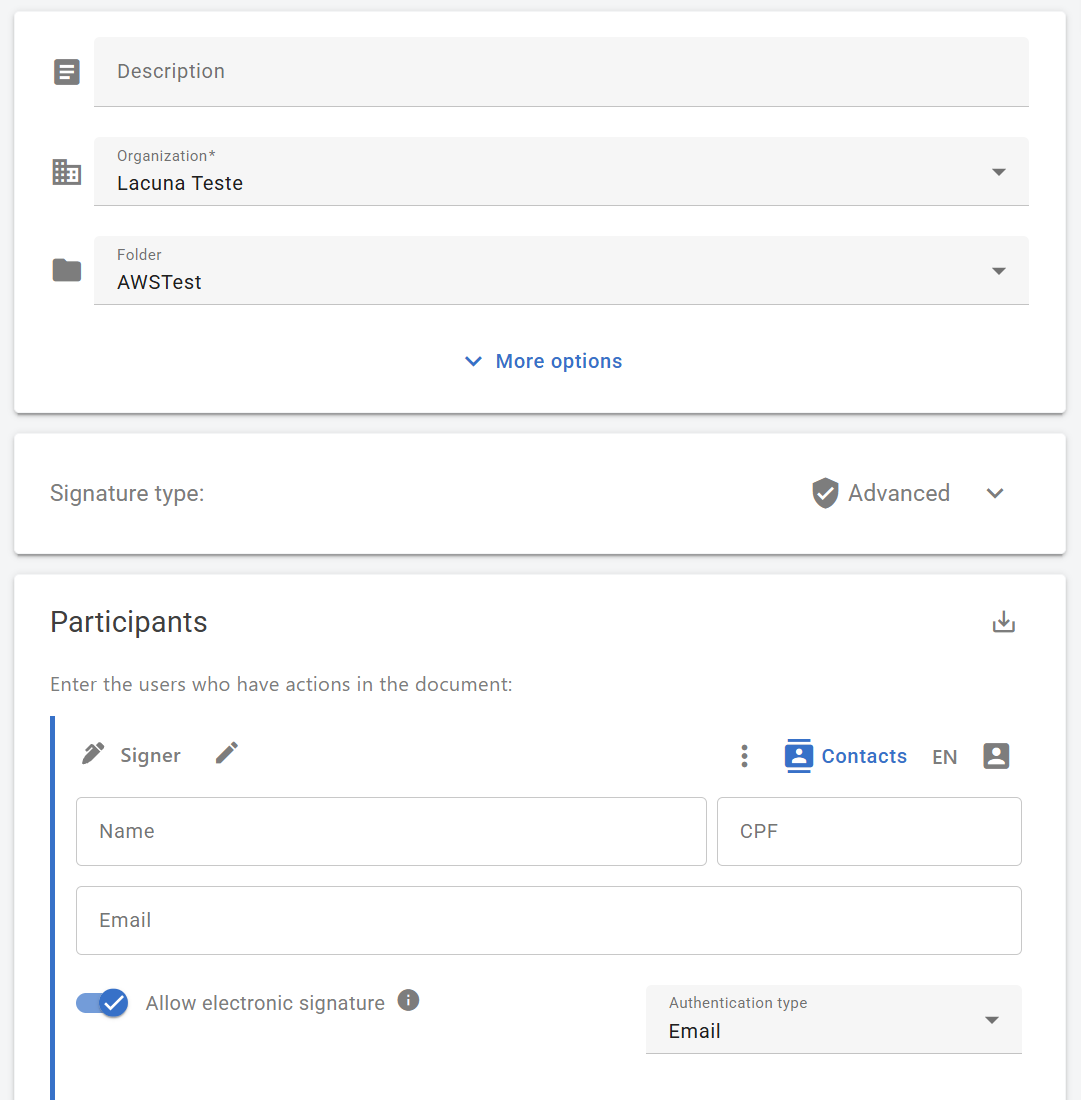
- Select New document, upload a PDF, and select the organization and the bound folder.
- Add the certificate holder as a participant of type Signer, with the name, the CPF contained in the certificate and the e-mail address. The holder can be the only participant or follow other participants; the task acts only when the pending action is the holder's.
- Select Send.
10.2 Expected result
Within seconds, the dashboard's Jobs page lists a job with the document's name, marked Lacuna
Signer, under the aws-signer profile:
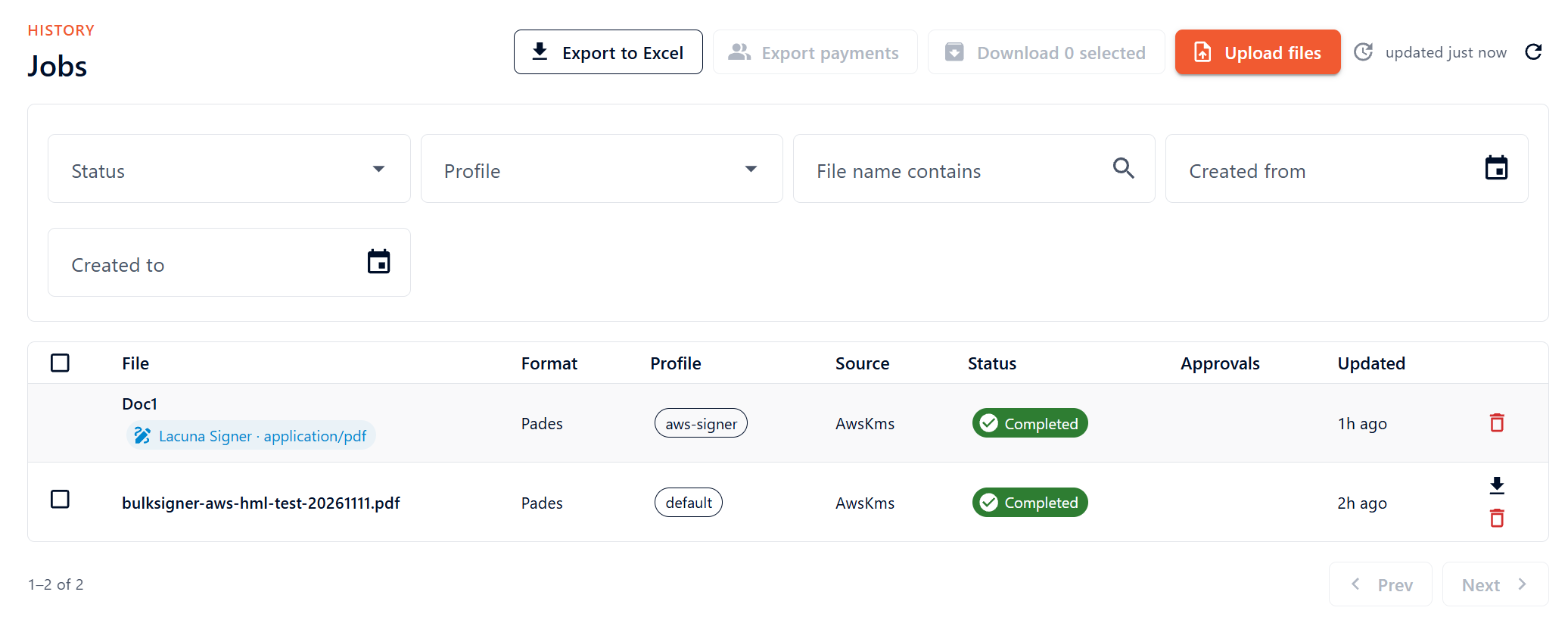
The job passes through the following states:
| State | Meaning |
|---|---|
| Queued | The document was detected and the job was created. |
| Processing | The task read the document back, started the signature and signed the hash in KMS. |
| Verifying | The signature was handed to Signer, which validates it and builds it into the document. |
| Completed | Signer accepted the signature. |
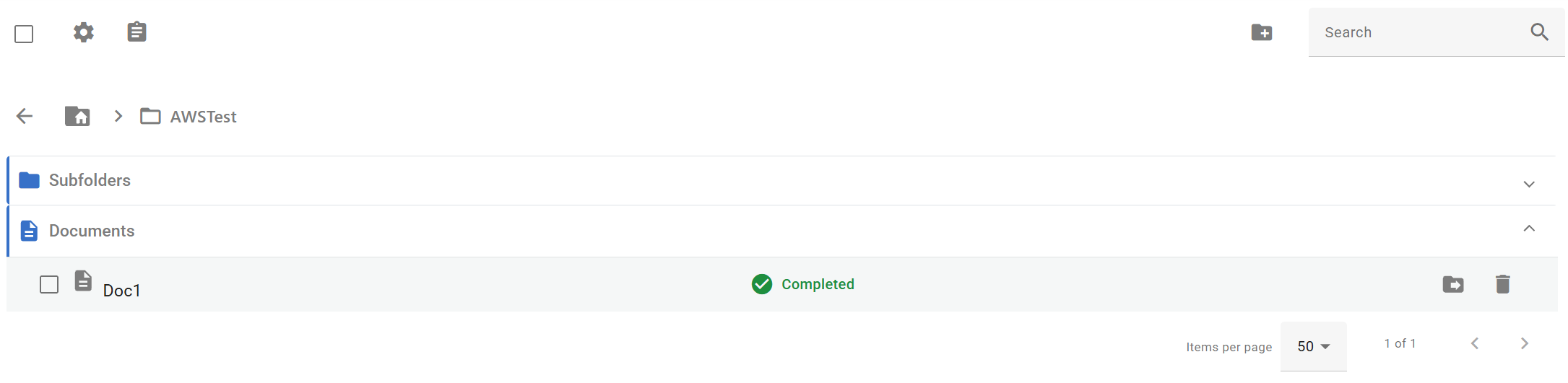
In Lacuna Signer, the holder's action is concluded and the document contains the signature. If the holder was the last participant, the document's status in the folder is Completed:
The CloudTrail event history shows the task role's Sign call on the key within a few minutes.
10.3 Verification from the command line
curl -s -H "X-API-Key: $KEY" "https://$HOST/api/jobs?profile=$PROFILE" | jq
curl -s -H "X-API-Key: $KEY" https://$HOST/api/ready/details | jq -r '.checks[] | select(.name=="signer-notifications") | .detail'
curl -s -H "X-API-Key: $KEY" https://$HOST/api/metrics \
  | grep -E 'bulksigner_signer_(notifications_total|folder_signatures_total|folder_jobs_enqueued_total)'
| Evidence | Expected value |
|---|---|
signer-notifications check | accepted; the last arrived at this instance at <time> |
bulksigner_signer_folder_signatures_total{outcome="signed"} | Incremented once per signature accepted by Signer. |
bulksigner_signer_notifications_total | Counts deliveries, by outcome. |
A document that is signed only minutes after its creation was detected by the sweep, which indicates that
the notification did not arrive. In that case, the signer-notifications check still reports that none
has arrived, or the unauthorized outcome is increasing. See Symptoms.
Operations
The operations of the base deployment are specified in
step 11 of Amazon ECS Fargate. In this deployment, every change to the
infrastructure or to the container's configuration is a stack update, not a change made in the console
or with the service's own commands: a resource changed outside the stack is overwritten by the next
update. aws cloudformation deploy keeps the value of every parameter that is not named:
aws cloudformation deploy --region $REGION --stack-name $NAME --template-file bulksigner-ecs-fargate.yaml \
  --capabilities CAPABILITY_NAMED_IAM --parameter-overrides <Parameter>=<value> ...
| Operation | Procedure | Notes |
|---|---|---|
| Upgrade | Copy the new version into ECR (step 3), pause the pipeline (POST /api/pipeline/pause), wait until no job is Processing or Verifying, run the update with ImageUri=<new image>, and resume (POST /api/pipeline/resume). | A task stopped during a signature requires the next boot to ask Signer how the job ended, and some of those jobs end Failed with signer-folder.interrupted (Lacuna Signer integration). The sweep runs while the pipeline is paused: new documents become jobs and wait in the queue. |
| Secret rotation | Store the new value in the secret, then start a new task: aws ecs update-service --region $REGION --cluster $NAME --service bulksigner --force-new-deployment, with the pipeline paused as for an upgrade. | A task reads its secrets when it starts. A new deployment does not change the stack. |
| Webhook secret rotation | Store a new random value in $NAME/signer-webhook-secret, start a new task as above, then enter the new value in the webhook in Signer. | The same value exists on both sides. Between the two changes, notifications are answered 401; Signer retries them and the sweep detects the remaining documents. No document is lost. |
| Signer API key rotation | Create the new key in Signer, store it in $NAME/signer-api-key, start a new task as above, and only then revoke the previous key. | With a revoked key, every sweep fails, and the signer-folder-sweep check fails after three consecutive failed passes. The check does not affect /api/ready, so the load balancer keeps the task. |
| Certificate renewal | Pause the pipeline. Import the new PFX with a new alias (step 2) and run the update with KmsKeyAlias=alias/<new alias> and SigningCertificate=$(openssl base64 -A -in <new>.cer). Then, on the page of each profile that uses the key, set the new alias under Edit certificate (the S3 object key does not change), start a new task as above, and resume. | The stack holds one key: the update replaces signing-material/$NAME.cer and moves the task role to the new key, so until the profiles name the new alias and a task has restarted, they are degraded. If the new certificate contains a different CPF, documents pending in Signer for the previous CPF have no action for the new holder. Each is recorded once as Failed with signer-folder.no-holder-action. Notify the users who create documents before the change. |
| Folder change | Save the new folder on the profile's Certificate panel. | Takes effect without a restart. Documents remaining in the previous folder are no longer signed by the profile. |
| Adding Entra ID to a running stack | Run step 4.2, then the update with EntraTenantId, EntraClientId and EntraClientSecretArn, with the pipeline paused as for an upgrade. | Sessions created by the API-key sign-in stop working. Existing profiles do not change. |
| Deactivation | Remove the webhook in Signer, then disable the profile on its page or change its method. | Updating the stack with an empty SignerEndpoint while a profile still uses the method does not prevent the boot. The profile becomes degraded, and its reason names the two missing keys. |
| Removal | aws cloudformation delete-stack --region $REGION --stack-name $NAME | Deletes every resource of the stack except two, which are kept on purpose: the bucket, with the work share, and a final snapshot of the database. Delete them separately when they are no longer needed; a new stack with the same Prefix cannot be created while the bucket exists. Not part of the stack, and not deleted: the KMS key, the ECR image, and the secrets of step 4. |
Interface contracts
Notification endpoint
POST /api/signer/notifications is called by Lacuna Signer and authenticated with
Authorization: Bearer <Signer:WebhookSecret>. The complete contract is specified in
REST API.
| Response | Code | Condition |
|---|---|---|
202 | — | A document in a bound folder was queued for a check, or was already queued. |
204 | — | Any other authenticated delivery: an event that cannot make a document await a signature, a folder that is not bound, the folder of a disabled profile, or a body that cannot be read. |
401 | signer-notification.unauthorized | The Bearer token is absent or incorrect, or another scheme was used. |
404 | signer-notification.not-configured | Signer:WebhookSecret is not set. |
429 | — | The rate limit of the route (RateLimiting:SignerNotification) was exceeded. Signer retries the delivery. |
503 | signer-notification.unavailable | The operational store is unusable on the instance, or too many checks are queued. Signer retries the delivery. |
Queued checks are held in memory. A restart discards those not yet performed, and the next sweep detects the corresponding documents.
Other endpoints used on this page
Authenticated requests send X-API-Key: <Auth:ApiKey>.
| Method | Route | Authentication | Used by |
|---|---|---|---|
GET | /api/ready, /api/ready/details | Anonymous; API key for the details | Verification (steps 7 and 10). |
GET | /api/profiles/{name} | API key | Profile verification (step 8). |
GET | /api/jobs?profile={name} | API key | Signing test (step 10). |
GET | /api/metrics | API key | Signing test (step 10). |
POST | /api/pipeline/pause, /api/pipeline/resume | API key | Deployment (Operations). |
GET | <Signer__Endpoint>/api/documents | None | Confirms the Signer API address: 401 without a key (step 1.1). |
AWS calls made by the task for the profile
| Service | Action | Resource | When called |
|---|---|---|---|
| Amazon S3 | s3:GetObject | signing-material/<name>.cer | When the profile is opened: during the save in step 8, and at each boot. |
| AWS KMS | kms:DescribeKey, kms:GetPublicKey | The signing key | When the profile is opened. |
| AWS KMS | kms:Sign | The signing key | Once per signed document. |
Error reference
Error codes
| Code | Origin | Meaning | Resolution |
|---|---|---|---|
signer-notification.unauthorized | Notification route, 401 | The token registered in Signer differs from the secret, was entered with the word Bearer, or the authentication type is not Bearer. | Correct the webhook in Signer (step 9). |
signer-notification.not-configured | Notification route, 404 | The webhook secret did not reach the task. | Check the task definition revision the service runs, and that the execution role can read the secret. |
signer-folder.no-holder-action | Job, Failed | The document is in the bound folder but has no signing action for the certificate's CPF: the holder is absent, was added as an approver only, or was added without the CPF. | Add the holder as a signer with the CPF. The next sweep detects the new action. Not retriable. |
signer-folder.signature-refused | Job, Failed | Signer refused the signature. Its validation results are recorded in the job history; the usual cause is the certificate (revoked, expired, or not the participant's). | Correct the cause reported by Signer, then retry the job. |
signer-folder.interrupted | Job, Failed | The task stopped during the signature. | Check the document in Signer, then retry the job. A retry ends Canceled if the holder's action is already concluded. |
error storing credentials … The stub received bad data | Docker Desktop for Windows, on the ECR docker login | Windows Credential Manager refuses the size of the ECR token. | Push the image with the .docker-ecr directory from step 3. An empty --config directory does not help. |
The public key of SigningCertificate is not the public key of alias/… | Stack, resource SigningMaterial | signer.cer is not the certificate of the imported key. | Pass the .cer that step 2 wrote for that alias. |
Alias arn:aws:kms:…:alias/… is not found | Stack, resource SigningMaterial | KmsKeyAlias names no key in the Region. | Pass the alias of step 2, with the alias/ prefix. |
The database setup task … stopped with exit code … | Stack, resource DatabaseSetup | A sqlcmd command failed. | The first failed command is in the log the message names: aws logs tail /ecs/$NAME --region $REGION --log-stream-name-prefix dbsetup. |
… already exists | Stack, any named resource | A resource with the same name exists: an earlier stack with the same Prefix, or its retained bucket. | Use another Prefix, or delete the earlier resource. |
The stack stays in CREATE_IN_PROGRESS at Certificate | Stack, ACM | The validation record does not exist, or the zone that holds it is not the authoritative one. | Create the record of step 5.3, in the zone the dig +short NS check names. |
Cannot create a snapshot because the database instance … is not currently in the available state | Stack deletion, resource Database | The stack was deleted while the RDS instance was still being created, and the final snapshot needs an available instance. | Wait for aws rds wait db-instance-available --region $REGION --db-instance-identifier $NAME, then delete the stack again. |
Circuit breaker in the Service event | Stack, ECS | The task did not become healthy. | The task's log: aws logs tail /ecs/$NAME --region $REGION --log-stream-name-prefix bulksigner. |
AADSTS50011 | Microsoft Entra ID, at sign-in | The redirect URI sent is http://…, or it does not match the app registration. | Confirm that HostName is the hostname users open, and the registration's https://<host>/signin-oidc URI (step 4.2). |
ThrottlingException, KeyUnavailableException | AWS KMS, recorded on the job | The KMS request quota, which is shared by every caller in the account and Region, was exceeded, or the key was unavailable. | See Troubleshooting. |
A job that ends Canceled carries no code: the document was cancelled, refused or expired in Signer, or
was already signed by the holder, before the task signed it. This is not a fault. Every signer-folder.*
code is specified in
Troubleshooting.
Symptoms
| Symptom | Cause | Resolution |
|---|---|---|
The task stops at boot and its log names Signer:Endpoint or Signer:ApiKey. | A key under Signer: is set without those two. Setting Signer__WebhookSecret alone is sufficient to require both. | Not reachable with the stack, which sets all of them or none. Check the task definition's environment. |
The task stops at boot and its log names Signer:WebhookSecret. | The secret has fewer than 32 characters, or has leading or trailing whitespace, usually a trailing line break in the secret's value. | Store a new value without whitespace in $NAME/signer-webhook-secret and start a new task (Operations). |
signer-notifications reports accepted; none has arrived… after a document was created. | Signer does not reach the load balancer: the URL registered in Signer is incorrect or uses http://, or the $NAME-alb security group does not admit Signer's addresses. | Correct the URL (step 9) or the $NAME-alb security group (step 5.1). |
| Documents are signed, but minutes after their creation. | The notification does not arrive, and documents are detected by the sweep. | See Troubleshooting. |
| The folder selector reports that Signer cannot be reached, or lists the folders of another organization. | Signer__Endpoint is not the address of the Signer API, or Signer__ApiKey belongs to another organization. | Correct SignerEndpoint with a stack update, or the secret $NAME/signer-api-key and start a new task (Operations). |
| Create profile is refused with a message about the certificate's CPF. | The certificate contains no CPF. | Use an ICP-Brasil e-CPF or e-CNPJ. See Troubleshooting. |
| Create profile is refused with a message about KMS or S3. | The task role lacks kms:GetPublicKey on the key or s3:GetObject on the .cer, the task role's ARN is not exempted from the key policy's deny, or the .cer does not match the key. | Correct the role or the key policy (steps 2 and 8.3). See Troubleshooting. |
The signer-folder-sweep check fails. | Three consecutive passes failed. The usual cause is a revoked or incorrect Signer:ApiKey. | See Troubleshooting. |
Errors of the base deployment that do not involve Lacuna Signer are specified in the Error reference of Amazon ECS Fargate.
Limitations
| Not provided | Alternative |
|---|---|
| A signed file in S3 | Signer stores the document. Download it from Signer; nothing is written to work/output/. |
| Verification of the result by Bulk Signer | None. Verification is disabled for this method, because Signer validates the signature when it builds it into the document. |
| The opposite direction: a file sent to Signer for a person to sign | The LacunaSigner method, which uses the same Signer:Endpoint and Signer:ApiKey, requires no further AWS change and is selected per profile. See Lacuna Signer integration. |
| More than one instance, verification of the database server certificate, metrics in CloudWatch, backups made by Bulk Signer | The limitations of Amazon ECS Fargate apply unchanged. |